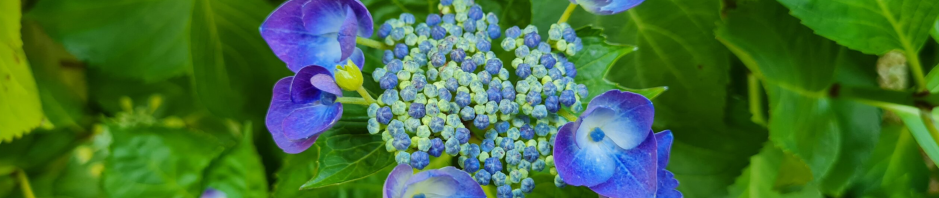

We’ve been having a bit of a hydrangea-fest here recently. Over the last couple of years my partner has become more and more interested in growing them and we’ve been visiting gardens in both Britain and France to see more.
What’s surprised me is what a wide range of colours, sizes and forms we’ve seen even within the same species. Apart from those already dotted around the garden, we’ve got fingers crossed about 50 cuttings sitting in cold frames which we hope will be ready to join them next year.
It set me thinking about where hydrangeas came from, how they reached our gardens and have been hybridised and developed,
 and why they still have a somewhat rather dour reputation summed up in a poem by Moniza Alvi
“The hydrangeas are massing
in gardens cherished by aunts
Grimly ornamental, by tiled paths…”

As usual the photos are mine unless otherwise acknowledged

To the majority of gardeners hydrangeas probably fall into just two main sorts – mopheads and lacecaps. These are both part of one large species: Hydrangea macrophylla, literally the big-leafed hydrangea, which has lots of different forms or sub-groupings depending on whereabouts they come from. There are however more cultivars of other species, such as H.paniculata and the oak-leaved hydrangea beginning to appear in the commercial market.

Hydrangeas are different to most other flowers in they don’t have showy or colourful petals. What we tend to think of as petals are in fact sepals, which serve the same purpose ie to attract pollinators. However the “flowerhead” on mopheads are almost entirely comprised of sterile sepals, with just a few tiny fertile flowers hidden away while on lace-caps the flowers are tiny but usually numerous and surrounded by bigger more colourful sepals. Whereas most other flowers lose their petals after they’ve been pollinated, the sepals of hydrangeas remain vibrant and on show for the whole season, which explains why hydrangeas make good dried “flowers”. The lack of obvious seeds also explains why it’s really only in the last hundred years or so that there has been much success in breeding new varieties.


Unlike many other well-known garden favourites the story of hydrangeas isn’t well or even often covered by garden or plant history books. In any case it’s actually two very different stories rather than just one because hydrangeas are indigenous in two widely separated areas of the world. One is east Asia, which is home to the majority of the species, and the other is north America. In both areas the fossil records suggest they’ve been around for at least 40 million years.

More recently these stories intertwine and with hybridisation between species and the breeding of almost countless garden varieties everything becomes more complex and difficult to unravel. As usual the taxonomy is never as simple as it appears in nursery catalogues. In any case, apart from a few key facts most books on hydrangeas generally skip over the history, so it’s been a frustrating experience trying to weed out fact from fiction.

There’s no doubt that hydrangeas make their first appearance in the historical record in Japan. Native species are mentioned in poetry and diplomatic correspondence from as early as the 8th century when plants were taken as gifts to the rulers of China. They were quickly adopted by the Chinese for their gardens and effectively became naturalised there. That’s unlike Japan where they weren’t widely grown in gardens probably because they were so prolific in the wild, and so didn’t have much social cachet for garden owners. It also didn’t help that their colours could change apparently at random – a trait we know to be caused by the acidity/alkalinity of the soil and the availability of “free” aluminium – and so they were also known as Nanahenge which literally means “seven transformations”.


As we’ve seen in previous posts Japan spent much of the 17th, 18th and 19th centuries in isolation but despite that there also seems to have still been a considerable amount of plant exchange between Japan and China. That might explain how, around 1700, James Cunninghame, a naval surgeon, was able to send back herbarium specimen of what was labelled an “embroidered ball flower”. This was a term used at the time to describe viburnums but which has been now confirmed as a purple flowered hydrangea. His specimen is now in the Sloane Herbarium at the Natural History Museum [HS 94 f21] Despite collecting it in China Cunninghame’s notes added that it was “ex insola Japonia” ie from the island of Japan.
There were also occasional hydrangeas seen or collected by a few of the Europeans based at the Dutch East India company trading base on the artificial island of Deshima in Nagasaki Bay. Amongst them was the physician Englebert Kaempfer who was in Japan from 1690-92, amongst the many plants he included in his Amoenitatum exoticarum (1712) was what he called a new kind of elder but which was actually an hydrangea.


Cunninghame and Kaempfer’s examples only reached Europe as dried specimens and its not until 1736 that the first viable seeds of hydrangeas reached Europe. However they were not from China or Japan but instead were of Hydrangea arborescens, one of the few species from North America. They had been collected by John Bartram, the pioneer nurseryman and sent over to England to his friend and correspondent Peter Collinson. Even so they didn’t flower for the first ten years leading Philip Miller, the superintendent of Chelsea Physic Garden, to write that it was “preserved in gardens for the sake of variety more than for its beauty,” I’m sure he’d have been mighty pleased when it did finally blossom because H.arborescens is well known today for cultivars such as Annabelle.

Known as “Seven bark” in its native country because of the way its bark peels in layers revealing different colours, it was described three years later by Jan Frederik Gronovius, a Dutch botanist based in Leiden in his book Flora Virginica . Gronovius had also been a patron of Linnaeus and it was Linnaeus who coined the botanical name for the hydrangea family which is rather bizarrely derived from two Greek words meaning water vessel, supposedly referring to the shape of its seed pods.
Hydrangea arborescens is listed in Hortus Kewensis 1787 as “Shrubby Hydrangea native to Virginia” although it didn’t appear in Curtis’s Botanical Magazine until 1799.
In the 1770s one of Kaempfer’s later successors at Deshima, Carl Peter Thunberg managed to collect two different hydrangeas in Japan. Since he wasn’t allowed off the island he did so by asking his Japanese servants to forage for fodder for his goat, then sorting through what they bought back. Like Cunninghame Thunberg thought that they were a kind of viburnum and when he wrote the first scientific description he named them Viburnum macrophyllum and Viburnum serratum, although they are now known as Hydrangea macrophylla [the big-leaved hydrangea] and Hydrangea serrata. [the hydrangea with saw-toothed leaves, although that’s now been subsumed into H.macrophylla as a sub-species]


However the first big breakthrough in the history of the hydrangea in Europe came in 1788 when an English surgeon, Alexander Duncan, based in the East India Company base outside Canton sent back a consignment of plants to Sir Joseph Banks at Kew. Amongst them was a hydrangea that was in flower when it finally arrived in London. It was taken to Bank’s house in Soho Square and put on show, causing quite a stir in botanical circles because its large round flower heads are a pale yellowy-green when they open and then slowly turn a pale pinky-mauve colour.
Now called “Sir Joseph Banks” its thought to be a natural sport/mutation of H. macrophylla which is indigenous to Japan but naturalised in China from where it had been collected. This new exotic quickly appeared in print in Sir James Smith’s Icones pictae plantarum rariorum under the name Hydrangea hortensis – of the garden. That name stuck for a long time.


Banks sent the plant on to Kew where because it was from Asia it was thought to be in need of sheltered conditions although in fact it doesn’t usually need protection as it’s almost completely hardy in Britain.
More importantly Kew’s gardeners discovered it was extremely easy to propagate and the Kew Record Book shows how plants of H.hortensis were soon being sent out. The exchange network among garden lovers was efficient and widespread, so for example a basket of plants including H.hortensis was sent to a Dr Willis on 31st October 1793, another on 10th Nov to Professor John Martin at Cambridge University, while more went to royal gardens at Windsor on 12th Nov. The following spring they were sent to Utrecht, and to Edward Ellcock, a garden loving plantation owner, in Barbados while in June 1795 H. hortensis was one of 230 plants sent to the Grand Duchess of Russia. In 1796 plants were sent to Spain and to Dr Anderson Superintendant of St Vincent Botanic Gardens, in 1800 to Mr De Lancey at Paris, and in 1801 to Hanover.

H.hortensis featured in Curtis’s Botanical magazine in 1799 with a discussion of what family it actually belonged to. Five different possibilities were listed: Kaempfer’s suggestion of an elder; Thunberg’s supposition it was a viburnum, he called the Chinese Guelder Rose; Smith’s new name of hydrangea and another botanist’s rather bizarre claim that it was a primula.
The final idea came from France where botanists had already determined that it was a new plant they had named Hortensia , the name that is still in use in France today.
By this point, about 10 years after its introduction, Curtis says it has already become “so very common” that it didnt really need any further description, although he discusses the plants variability of colour, the two kinds of florets it can but doesn’t always produce, and its hardiness.


Hydrangea quercifolia
Easily raised by cuttings H.hortensis rapidly entered commercial production. By 1838 Loudon lists several kinds of hydrangea in his encyclopaedia of trees and shrubs growing in Britain. There was also the North American H.arborescens which he says was available in London nurseries for 1s6d; H.Nivea, introduced 1786 and H.cordata from Carolina introduced c1806; and H.Heteromalla introduced in 1821 from Nepal. He also includes H.quercifolia from Florida and which he’d describes as “the most interesting of the American kinds, available in London for 2s6d.”
It had been discovered by William Bartram in the 1770s, nicknamed the Swamp Snowball and illustrated in his book with the comment that “the whole panicle [of flowers] are truly permanent , remaining on the plant for years, until they dry or decay.” The oak-leafed hydrangea eventually reached Europe in 1805.

Finally Loudon has a long section on H hortensis. Noting that is abundant almost everywhere he records some extraordinary, indeed almost unbelievable, instances of large hydrangeas growing outdoors: “One at Sydenham, in Devonshire, has had 1000 heads of flowers expanded on it at one time. One at Redruth, in Cornwall, is described as being as big as a large haycock. In Pembrokeshire, at Amroth Castle, a plant, 33 ft. in circumference, and 6ft. high, has had 832 heads of flowers expanded on it at once. In Sussex, at Ashburnham Place, a plant, 30 ft. in circumference, and 5 ft. high, produced 1072 heads of flowers in one season. In Scotland, in Argyllshire, at Lochiel House, a large plant furnished from 600 to 700 flowers, all fully expanded at the same time. At St. Mary’s Isle, in the Stewartry of Kircudbright, a plant, 32ft. in circumference, produced 525 heads of flowers ; and one in Fifeshire, at Dysart House, 40 ft. in circumference, and 6 ft. high, produced 605 flowers.” He ends by saying that plants were available in the London nurseries, from 6d. to ls. each; while in France they cost 2 to 6 francs and were 50 cents in New York.


So hydrangeas were now cheap and widely available, however, up to this point there was little or no chance of anyone trying to hybridise because these mophead hydrangeas were sterile, and didn’t appear to produce seeds.
That all changed with the opening of Japan to western trade and influence in the 1850s and 60s. First of all Philip von Siebold [see previous posts for more info] who seen and described H.paniculata, before he had been expelled from Deshima by the Japanese, returned to Japan. Now he succeeded in sending back both the species and the cultivated form of H. paniculata.

More importantly Plant hunters from commercial nurseries notably Veitches of Exeter began to scour the country for new exotics for the British and European markets.

In particular it was Charles Maries who collected over 500 different plants including two lace-cap hydrangeas, H. macrophylla mariesii, and H.serrata ‘Rosea’ although these do not seem to have made an immediate stir in Britain. What did cause a stir was a pure white large lowered mophead that Veitches named “Thomas Hogg” after a well-known nurseryman and garden writer.


Other new introductions from Japan include ‘Floribunda’, discovered by Russian botanist Carl Maximowicz in a Japanese nursery in the 1860s, and sent along with many other plants to the St Petersburg botanic garden. In 1878 H. anomala petiolaris the climbing hydrangea was introduced to Kew via Baden Botanic Gardens while ‘Praecox’ was raised from seeds collected on Hokkaido Island by Charles Sargent of the Arnold Arboretum in 1897.

Meanwhile Ernest “Chinese” Wilson was plant hunting in western China. He identified and described 25 different species, mainly from the cool temperate zones of the country at 5,000-10,000 feet. These included H.sargentii, H.villosa and the black stemmed, H.macrophylla Nigra which is now being used to produce a new range of quiet startling cultivars.
Eventually Veitches range of hydrangeas as seen by a French nurseryman Albert Truffaut who took them back to France where they were shown at the Société d’Horticulture in Paris.

Several important nurseries notably that of the Lemoine family of Nancy [famous for breeding others shrubs notably lilac] began hybridisation programmes after they discovered that some of the seemingly sterile species do occasionally have a few fertile true flowers hidden away, and for much of the 20thc French nurseries continued to dominate commercial introductions.

Since then there has been an indicate amount of crossing and recrossing with hundreds of named cultivars of H.macrophyllum in particular commercially available. Breeding of H.paniculata is fast catching up too. To see them there are several hydrangea hot spots.

Principal amongst them must be the Shamrock Garden Hydrangea Collection, at Varengeville-sur-Mer in Normandy. Stretching over more than 2 hectares it is the largest collection in the world. Plants are arranged chronologically by place of origin and discovery or breeder. As you might expect there are a series of YouTube videos about it, with several by the owners Robert and Corinne Mallet including this one. Others are linked via their website.

But in fact the whole of coastal north west France is a haven for hydrangeas, as is Cornwall, and slightly further afield hydrangeas have become naturalised on Madeira and the Azores – especially, nicknamed the Blue Island, which has flourishing colonies of deep blue H. macrophylla. Otherwise the place to go still has to be Japan.


Although most famous for its plum and cherry blossom festivals, there is an equally important and impressive one in June and July as the rainy season gets under way and the hydrangeas – known as Ajisai -start to bloom. Gardens all over Japan showcase one of their own native flowers, although these days mostly with new cultivars. There’s even a hydrangea train! A quick google search will show you how impressive it must be – although one in particular stood out for me while I was looking: Minamizawa Ajisai Mountain, a garden of 10,000 mainly blue and white Hydrangeas, created by one man and his family.
Time to save up for a trip to Japan!


 The Garden History Blog
You must be logged in to post a comment.